



Post Cycle Therapy
After a cycle, we have one goal: to hold onto the gains we made during the cycle. Unfortunately, this is easier said than done, because the levels of various hormones and other substances that were circulating around your body during the cycle (huge amounts of testosterone, insulin-like growth factor, growth hormone, and lower amounts of muscle-wasting glucocorticoids) are now changing. Sadly, they are making way for lower amounts of the hormones we want for building muscle, and higher amounts of the catabolic ones. What needs to be done, as quickly as possible, is to get your body to begin production of your own natural anabolic hormones, and produce less of the catabolic ones. Unfortunately, your body has other plans.
But then, so do I…
…and I’m very confident that this protocol will allow you to recover your own natural hormonal levels quickly and lose far less of the gains you worked so hard for on the cycle. This protocol, which is typically implemented after a cycle is called “Post Cycle Therapy” or “PCT” for short.
First, I’m going to tell you what anabolic hormones are typically low when a cycle ends, and which catabolic ones are high, then I’ll tell you what drugs can change that condition as fast as possible. Is all of this necessary? No, not at all. You can skip to the end of the article and look for a little chart I made - the extent of my computer skill - which has all of the dosage recommendations and compounds involved to properly recover from your cycle. I think, however, that you’ll see some very odd recommendations if you simply skip to the end, and will find yourself reading through the whole article to find out where they came from - or maybe you’ll just try to find out what’s gotten into me?
I’m not re-inventing the wheel here, and you may have seen a piece of this information elsewhere (possibly in something I’ve written, possibly somewhere else on the internet or in a magazine), but I’m sure of two things:
- You’ve never seen this PCT protocol anywhere
- This is the most effective PCT you’ll ever see
At the age of puberty, Gonadatropin Releasing Hormone (GnRH) is increasingly released from the Hypothalamus, in turn causing the secretion of Follicle Stimulating Hormone (FSH) and Luetenizing Hormone (LH) from the pituitary, and finally the male gonads (testes) are then stimulated by those pituitary hormones (LH and FSH). (1). FSH, although generally thought to only have a role in production of sperm, actually aids the in regulation of Leydig Cell function (2), while LH directly causes the Leydig Cells in the testes to secrete androgenic hormones such as testosterone (which is causes a surge in other anabolic hormones: Insulin Like Growth Factor, Growth Hormone, etc…).
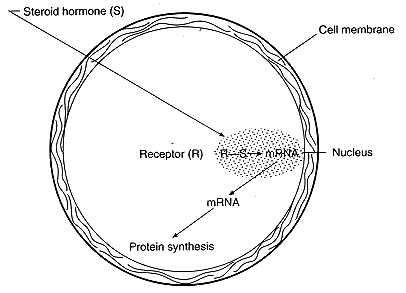
Androgens do this by then targeting other tissues inside the body, either by attaching to the Androgen Receptors (AR), which are found primarily in the cytoplasm of specific cells, or by what’s known as non-receptor mediated effects. When an androgen (your own natural testosterone or an anabolic steroid you’ve injected or ingested) binds to a receptor inside the cell, it activates the transcription of specific genes. What does this mean? Don’t worry, it just means that the steroid molecule gives the cell a message to do something. In the case of testosterone, for example, one of the messages it sends to the cell is to increase nitrogen retention in your body, thus allowing you to use more of the protein you take in, and build more muscle. In the case of testosterone (or anabolic steroids in general), this transcription causes a lot of different anabolic effects to take place: an increase in IGF, a decrease in cortisol, an increase in Red Blood Cell count, and the increased protein synthesis I already told you about.
This is not to say that AR binding is the only thing that causes anabolic or androgenic effects, however. Oxymetholone and Methandrostenolone (Anadrol and Dianabol) both bind very weakly to the AR yet are both highly anabolic and androgenic. The diagram below is an example of an androgen’s entry into a target cell, where it (in this case) stimulates protein synthesis, which is a major anabolic effect:
Under the control of this heightened state of androgens, you also go through androgenic development as well as anabolic development. This can be seen in puberty when males grow body hair experience voice changes, as experience genital development and growth.
Another characteristic of androgens in the body is that they are subject to what’s known as a “negative feedback loop”. Lets review one of the first things I mentioned, ok? Your Hypothalamus secretes GnRH, thus making the pituitary secrete LH & FSH, finally in turn causing the testes to stimulate the Leydig cells to produce testosterone (by conversion of cholesterol), remember? Ok, now, once testosterone is created however, it has the ability to in turn to undergo various metabolic processes that will inhibit GnRH, which in turn inhibits the secretion of LH and FSH, and that brings a halt to natural testosterone production. Once testosterone has stopped being produced, it no longer sends this negative signal, and GnRH eventually begins to do its job again. In this way, your body prevents excess hormones from being secreted and thus maintaining homeostasis (the status quo… in this case a state where you are neither gaining nor losing muscle) (1). This negative feedback loop is partially why we use anabolic steroids…we want more testosterone for anabolic purposes (or more Anavar or whatever) than our body will let us produce (not that our bodies produce Anavar, but you get the idea). When we use that injectable testosterone, it sends the message to our body to begin the negative feedback loop and discontinue producing/secreting the hormones that cause our natural testosterone production. The chart below clearly shows this process, displaying both the negative and positive feedback system(s):
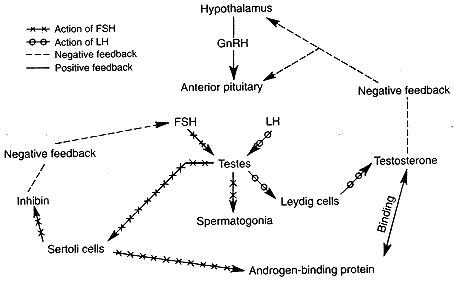
So what I’m saying is that anabolic steroids increase androgen levels in the blood, bringing a halt to GnRH, making the pituitary gland (eventually) responds by reducing the release of LH; this loss of LH has the effect of shutting down testosterone, of course, which you know is produced by the Leydig cells in the testes after they are stimulated by LH. Am I being repetitive? Yes. Do you need to understand all of this in order to understand the PCT protocol I’m about to outline? Yes. Remember, the negative feedback loop is, of course, no problem while we are on a cycle. Want more testosterone (or androgens) in your body? Fill up a few more syringes!
But all good things come to an end, and most of us choose to end our cycles at some point. At this point, while there is still some androgens floating around in us, our natural production won’t begin, and even once they are out, there may be some lag time before your body figures out that it needs to start producing its own androgens again. As I said before, this lag time is severely catabolic and it’s where you lose a lot of your gains. SO what we need to do is coax the body into quickly producing its own androgens.
One of the first drugs we’ll consider for this purpose is what is typically called a SERM. Nolvadex (Tamoxifen) is a SERM (Selective Estrogen Receptor Modulator, which means that it has the ability to act as an anti-estrogen with regard to certain genes, yet also acting as an estrogen with respect to others. That’s the “selective” part I guess. It does this by blocking gene transcription in some cases, and initiating gene transcription in others (3). Luckily for us, it has estrogenic effects on bones (meaning it increases their density), and blood lipids -meaning it lowers cholesterol-, (4)(5)as well as preventing gynocomastia by preventing estrogen gene transcription in breast tissue.
However, it acts as an anti-estrogen in the pituitary, thus increasing LH and FSH, which results in an increase in testosterone. 20mgs of Nolvadex will raise your testosterone levels about 150% (6)...Nolvadex actually has quite a few applications for the steroid using athlete. First and foremost, it’s most common use is for the prevention of gynocomastia. Nolvadex does this by actually competing for the receptor site in breast tissue, and binding to it. Thus, we can safely say that the effect of tamoxifen is through estrogen receptor blockade of breast tissue (7).
Estrogen is also important for a properly functioning immune system, and not only that, but your lipid profile (both HDL and LDL) should also show marked improvement with administration of tamoxifen (34).
Nolvadex also has some important features for the steroid using athlete. In hypogonadic and infertile men given nolvadex, increases in the serum levels of LH, FSH, and most importantly, testosterone were all observed (35)It can also block a bit of estrogen in the pituitary, which is a great benefit when used with HCG (more on that later) (36)(37). The increase in testosterone Nolvadex can give someone with a dysfunctional is basically that 20mgs of Nolvadex will raise your testosterone levels about 150% (6)...Why don’t we use Clomid, another SERM? Well, basically because it takes much more to do the same thing.
In comparison, it would require 150mgs of Clomid to accomplish that type of elevation in testosterone, but Nolvadex also has the added benefit of significantly increasing the LH (Leutenizing Hormone) response to LHRH (LH-releasing hormone) (6). This most likely indicates some kind of upregulation of the LH-receptors due to the anti-estrogenic effect Nolvadex has at the pituitary. Although both Nolvadex and Clomid are both SERMs, they are actually quite different. As you already know, Nolvadex is highly anti-estrogenic at the hypothalamus and pituitary, while Clomid exhibits weak estrogenic activity at the pituitary (7), which as you can guess, is less than ideal. It should be avoided for the PCT I’m suggesting…and in fact, avoided in general…it’s simply not as good as Nolvadex.
Need I even add that the 150mgs of Clomid you need to get the hormonal increase experienced with 20mgs of Nolvadex is much more expensive? So lets dump the Clomid…and no, using it along with Nolvadex will provide no “synergy” that I’ve ever seen in any relevant study.
SO how much Nolvadex should you use during PCT? I favor using 20mgs.day, although to be totally honest, you can probably even get away with far less than that. Doses as low as 5mgs/day have proven to be as effective as 20mgs/day for certain areas of gonadal stimulation. (8) 20mgs/day, however, is a dose that myself and others have used with great success, and the research I’ve done in this area typically uses this milligram amount. SO lets stick with 20mgs/day for now.
So that effectively suggests Nolvadex can not be used at Mega-doses to get a mega-increase in your natural hormones. We can’t use huge doses of any Anti-Estrogen, actually, and expect huge increases in our natural hormones, actually. Arimidex (an Aromatase Inhibitor –which means it stops the conversion of testosterone into estrogen-another drug used to fight breast cancer like Nolvadex) exhibits basically the same effects when .5mgs or a full 1mg is used (9) and I have even read studies where up to 10mgs/day of Arimidex is studied with no clear benefit over 1mg/day. Letrozole (another Aromatase Inhibitor) is capable of inhibiting Aromatase maximally at a mere 100mcg/day (10.). So clearly we need to add in other compounds to our PCT, because Mega-Doses of one compound will not I think it’s absurdly funny to see people recommending upwards 40-80mgs/day of Nolvadex, or a full milligram (or two!) of Arimidex, in their post-cycle or on-cycle suggestions. I’d steer very clear of listening to anyone who makes those types of recommendations…
All of this tells me that you can’t simply use mega-doses of Anti-Estrogens or SERMS to do anything more than reasonable doses. It must be, therefore, that your body can only respond with so much vigor to any one drug in those families. So lets add in another drug or two, ok? This way we can use reasonable doses of a few drugs and produce some synergy…hopefully decreasing our recovery time.
We’ll need something to go with Nolvadex, which acts in a different manner, and Human Chorionic Gonadatropin (HCG) is the clear choice here. Here’s where things get a bit controversial (no, really…I know you , because I’m pretty much the only person around (currently) who recommends HCG for Post-Cycle Therapy. Although I’m seen as Old School in this respect, really, this is a totally new paradigm for HCG use, made possible only by the inclusion of the other compounds I am introducing to you for PCT. HCG is the natural choice, as it has been used successfully to cure AAS induced (11), and this alone warrants its inclusion to our cycle.
HCG is a peptide hormone manufactured by the embryo in the early stages of pregnancy and later by the placenta to help control a pregnant woman’s hormones (can anything really be said to control a pregnant woman’s hormones except ice-cream and chocolate?). Obviously, as you can guess from the name, it is a substance that stimulates the gonads (hence: gonadotropin). It does this by initiating gene transcription that is identical to that of Luetenizing Hormone, thereby causing the Leydig Cells to produce testosterone. Sounds great right? We can stimulate LH and FSH production with our Nolvadex, and then directly stimulate the Leydig Cells as well, to produce tons of testosterone by different routes! Well...it’s not all that simple.
Unfortunately, while HCG increases Testosterone, it increases estrogen as well(12). As you probably know, estrogen acts directly on the Leydig cells to effect changes in the activities of enzymes important for testosterone synthesis (13) and may actually be considered an important part of that negative feedback loop I mentioned earlier. In addition, an increase in circulating levels of LH have been shown to induce down-regulation of LH-receptors in both rodent studies (14), as well as in human studies (15); since HCG mimics LH, you can expect it to do the same. This LH downregulation can cause an increase in steroidogenic cholesterol (the cholesterol earmarked by your body for conversion into testosterone). (16).
Thus, after the initial HCG induced surge in testosterone is over, if you have used enough to downregulate your LH-receptors and increase estrogen too much, then more steroidogenic cholesterol is available. This is telling me that less is being converted to testosterone. In fact, rodent models suggest that if you take a dose large enough to cause a sharp increase of plasma testosterone, you will actually desensitize your Leydig cells to your next shot, and will possibly not experience any rise in testosterone from the second dose at all, or may only experience a very slight one at best (17.). Since this is due to LH-Receptor downregulation, and that occurs in human models too, it is pretty fair to assume that if your first dose of HCG is too large, your second won’t be very effective. Unfortunately, this lack of an increase in testosterone doesn’t necessarily mean that the HCG may be unable to increase circulating levels of Estrogen (18) And remember that increase in Estrogen will (most likely) cause your body ultimately to produce less testosterone.
Low LH post-cycle is not the primary cause of slow recovery, because LH generally rises to levels above baseline after a cycle much sooner than testosterone production does. This is probably because the pituitary is working very hard to get your atrophied Leydig cells to start producing testosterone again. HCG should also bring back testicular volume; I feel the need to mention this because it’s important to me and I suspect most men as well. It would also appear that HCG works very well when it’s used on men who have low levels of LH to begin with (as you would be after a cycle), as many studies on pre-pubertal boys and Hypogonadotropic Hypogonadal men would suggest (19)
This suggests that a pre-exposure to normal LH levels or gonadatropins in general is necessary for HCG-induced Leydig Cell desensitization. This, of course is not a problem for us, as we’ll be using it when LH/Gonadatropin levels are very low anyway …we just need to stop using it before we regain normal function, or it will work against us eventually. (19) (20). Luckily, the temporary Anabolic steroid induced hypogonadism that is experienced after a cycle basically allows us to respond to HCG like anyone with low LH levels (21), and thus, as I told you, a lot of the possible inhibitory effect of HCG is not going to be relevant because there was no prior “priming” by circulating gonadotrophins. This is great news for us, because we are going to be using HCG during PCT, when we need to get back some HPTA function, and not when we have levels of gonadatropins high enough to cause HCG-induced desensitization.
But are we still risking some inhibition and possibly delaying our recovery by using HCG? Probably not…you see, some studies in humans have shown that HCG does not actually have a direct effect on inhibiting LH release in men (22)(23), but rather (probably) works to inhibit LH secretion indirectly, simply by stimulating the production of testosterone (thus activating the negative feedback loop). Another factor involved is the induction of testicular aromatase, which raises estrogen levels, again causing inhibition. Unfortunately, yet another process, the downregulation of the Leydig Cell LH receptor itself, seems to also play a role in high dose HCG testicular desensitization. This is also done by HCG actually blocking the conversion of 17 alpha-hydroxyprogesterone (17 OHP) to testosterone (24). Nolvadex actually stops this blocking-action of HCG from taking place (25). Most likely, because of Nolvadex’s direct antiestrogenic effect and LH-upregulating effect on the Pituitary, suppression of gonadotropins via HCG is (25) almost totally stopped with concurrent administration of Nolvadex! So if we Use Nolvadex and we are only using HCG when we are low in gonadatropins, we won’t be inhibited by it at all! Right?
Well…maybe…but there’s still the issue of estrogen caused by that HCG-stimulated surge in testosterone. Well…we can use low doses (300iu or so) to avoid some of that major spike in estrogen, and thus cause far less inhibition from the HCG (26). Of course, I’d want to use a bit more HCG per injection (500iu), if I could, to get my body functioning fully more quickly, and lose less of my gains. Maybe we can get away with taking some Vitamin E with our HCG, since it increases the responsiveness of plasma testosterone levels to HCG, making them significantly higher during vitamin E administration than without it (27). So we can get a better response with our HCG by taking Vitamin E (I recommend 1,000iu/day), but that doesn’t get rid of the problem that we have, which is the estrogen increase the HCG will cause.
Lets solve that pesky estrogen problem now….
Lets add in an Aromatase Inhibitor! Which one, though? Well, since we are already using Nolvadex, we can’t use Letrozole or Arimidex, as the Nolvadex will actually greatly decrease the blood plasma levels of them (28)!
So we have to use Aromasin (exemestane) as our AI, because it’s an aromatase inactivator, meaning it makes estrogen receptors useless, and instead of just inhibiting production (as an anti-aromatase would do) it cuts off production totally. Aromasin can also cause androgenic sides (29)(30)(31), which may help to elevate your mood while you are on PCT. This final drug in my recommended PCT can effectively remove up to about 85%+ of estrogen from your body (32). Most importantly, using Aromasin together with Nolvadex doesn’t reduce exemestane’s effectiveness (33). So now, I think the problem of ANY inhibition possible with HCG is solved, and we can use that 500iu/day dose that I wanted to use previously.
With this PCT, there will be a rapid increase in LH, FSH, and testosterone, as well as almost a complete block on all the factors that could be causing your natural hormones to be delayed in returning to baseline. For this reason, I feel that the second your cycle is over is when you should start this PCT (a week after your last shot, or the day after your last pill is fine). Remember, waiting for some of the extra androgens you’ve been taking to leave your body is nonsensical, as we want to start recovery as soon as possible to retain maximum gains.
There is no evidence to suggest waiting any length of time after your cycle is over will increase PCT effectiveness…it simply prolongs the time you aren’t doing anything positive to regain your natural hormones. And how long do we run this for? Well…we need to stop the HCG relatively soon for reasons discussed earlier. But the Nolvadex, and Aromasin can be used for awhile longer. Ideally, we’d be getting weekly blood work, but we could also get it done monthly, and just running this PCT until we see our natural hormones restored…but weekly bloodwork isn’t really an option for most of us. Failing the option of monitoring recovery with blood-work, I’m going to give you my best thoughts on the time you should be running your PCT. It’s important to note I haven’t discussed nutrition or other compounds that may be beneficial…this is because in this article, I am primarily concerned with the restoration of hormonal function, nothing else. And with no further delays, here are my recommendations for PCT:
| Week | Nolvadex | HCG | Aromasin | Vitamin E |
| 1 | 20mgs/day | 500iu/day | 20mgs/day | 1,000iu/day |
| 2 | 20mgs/day | 500iu/day | 20mgs/day | 1,000iu/day |
| 3 | 20mgs/day | 500iu/day | 20mgs/day | 1,000iu/day |
| 4 | 20mgs/day | 20mgs/day | ||
| 5 | 20mgs/day | |||
| 6 | 20mgs/day |
About The Author
Anthony Roberts has been researching anabolic steroids for over a decade and is the author of the book, Anabolic Steroids: Ultimate Research Guide. He began his research at the age of seventeen while he was a competitive martial artist, ultimately winning a silver medal in his state martial arts tournament in the black belt division. His firsthand experience in steroids began after he switched sports and began playing rugby, in which he ultimately made two consecutive appearances at the hooker position in the national collegiate all-star games.
From Mesomorphosis.com