


Increase Your Bench Press
By Lee Hayward, author of "Blast Your Bench" and "Bio-Genetic Muscle Building Program"
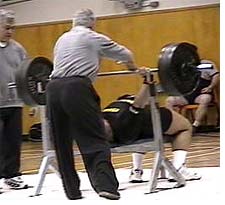 How much can you bench press? If you have been working out for any length of time you have certainly heard this question. The bench press is the ego exercise. You can add poundage to your max squat, dead lift, shoulder press, etc. But for some reason it doesn’t give you the same satisfaction as adding poundage to your max bench press.
In this article I am going to outline some great tips on improving your bench press technique and how to lift heavier weight when testing your one rep max bench press.
To increase your Bench Press poundage you do not concentrate on strict isolation, but rather on developing power in the muscles. That means that you must use your entire body to lift the weight.
Position yourself on the bench and try to arch the back as much as possible while keeping the shoulders, head, and butt on the bench. This position will lessen the distance the bar must travel and will also allow the legs to drive the shoulders into the bench for much greater power. Your feet should be flat on the floor, shoulder width apart. Grab the bar just a bit wider then shoulder width. Tighten your entire body and squeeze your shoulder blades together behind you. Then you flex your butt and press your feet into the floor.
Get a spotter to help you lift the weight off the rack. You will waste energy and make it harder to get in the right position if you lift the weight off the rack by yourself.
Grip the bar firmly and tuck your chin into your upper chest, when you are ready to lower the bar inhale and expand your chest and belly, this will help you generate more power. As you lower the bar keep your elbows tucked so that your upper arms are at a 45 degree angles to the sides of your body. Do not let your upper arms go straight out to the sides because it will place too much strain on your shoulder joints and reduce your power.
Lower the bar to the point where your chest and abdominals meet. Keep the bar directly over your wrists and elbows. As soon as the bar touches your body, you need to generate as much thrust and energy as you can, to power the bar back up.
Exhale as you lift the weight up. Push the bar up in a straight line. Keep your chest and shoulders tight, keep your elbows tucked, and focus on benching with the triceps. Once you lift the bar off your chest straighten out the arms using the triceps to lock out the rep.
Finding Your One-Rep Max
To determine your 1 rep max you should not train for 48 hours. You should also perform the test before you do any other exercise. If you try and test your 1 rep max after a hard workout you will not be able to lift maximum weight. You need to warm up properly before lifting, this will help to increase your strength and prevent injury. Start off by doing 5 minutes of light cardio (stationary bike, treadmill, jogging in place, etc.). Then do the following stretching and warm up exercises.
Arm circles:
Keep your arms straight and perform arm circles forwards and backwards. Do 15-20 circles in each direction.
Push ups:
Do a couple sets of push ups (do 20-30 total reps, i.e. 2 sets of 15 reps). Do not work too hard, you only want to get the blood flowing and warm up your joints.
Arm rotation for the rotator cuff:
Warm up your shoulder joints by standing with your arms straight out to the sides, bend your elbows so they are at 90 degree angles. Rotate your arms so that your forearms point up and then rotate your arms so that your forearms point out in front. Do 20-30 rotations.
Rear dumbbell flyes:
Hold a pair of light dumbbells and bend over at the waist. Keeping your back parallel to the floor, move just your arms and lift the dumbbells to the back in a fly motion. Really focus on squeezing the back of your shoulders together as you lift the dumbbells. Do 3 sets of 15-20 reps.
Here's how to determine your 1 rep max
(Note: make sure to have an experienced spotter handy just in case you need help lifting the barbell.)
Do a couple of light sets for 5 reps. (do not wear your self out with too many reps)
Rest 2 minutes.
Increase the weight and do a set of 3 reps.
Rest 2 minutes.
Increase the weight and do another set of 3 reps.
Rest 3 minutes.
Increase the weight and do a single rep.
If you fail to lift the weight, rest 3 minutes, reduce the weight, and try to do a single rep again. If you succeeded in lifting the weight, rest 3 minutes, increase the weight, and try to do a single rep again. Keep repeating this process until you have found the maximum weight that you can lift for a single rep.
Write down your 1 rep max and the date you lifted it, this will help you keep track of your progress.
If you want more specific training and dietary strategies for increasing your bench press, then check out my BLAST YOUR BENCH website.