

You Ain't Squat 'Till You SQUAT!
By Sean Nalewanyj, author of "The Truth About Building Muscle"
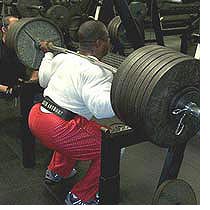 Simply put, squats are the most difficult, intimidating and painful exercise you could possibly have in your arsenal. They require massive amounts of discipline and willpower to perform correctly. After you have performed a set of squats to failure, you'll know exactly what I'm talking about! They are also a challenging exercise to master from a technical standpoint. All this aside, they are also the most productive. Squats have packed more muscle onto skinny frames than any other lift out there. Because of the degree of difficulty, squats also force your body to release higher amounts of important anabolic hormones, such as testosterone and growth hormone, thus resulting in total body muscle growth. In addition, squats also cause what is known as a "spillover effect": a strength gain in almost all of your other exercises. When I started squatting to failure, my bench press increased by 20 pounds! If you're looking for serious muscle gains and you don't already squat, you'd better get started. Quite simply, they really, really work.
Unfortunately, many people have yet to experience the benefits of heavy squatting. Why? It seems that people will come up with just about any excuse they possibly can in order to steer clear form the squat rack. How many times have you heard the all too common "They're too hard on my knees", or "I heard they stunt your growth." What do I say to that? Nonsense! With the exception of a very small population of lifters, everyone can squat! The main reason that the squat rack seems to collect dust faster than any other piece of equipment in the gym is simply due to the amount of intensity one must generate in order to squat effectively. In addition to that, many myths have come up over the years that have convinced people to steer clear of this exercise. Let's take a look at these myths and clear them up once and for all.
1: "Squatting will ruin your knees"
Just as the muscle tissue in your body strengthens when exposed to stress, the tendons, ligaments and other connective tissues in your body will also thicken in response to weightlifting. Because of this, heavy squatting can only increase knee strength. By strengthening the supporting muscles around the knee, you will also end up with much greater knee stability and strength. Knee problems when squatting will only occur through improper form, namely relaxing in the bottom position. When you relax the knee joint, it separates slightly, placing it in a compromising position. The solution? Don't relax in the bottom position! It's that simple. Keep everything tight and flexed and you'll have no problems.
2: "Squatting is dangerous to the spine"
Again, weightlifting will only strengthen ligaments and connective tissues. If you like, you can use a weight belt when performing heavy, low rep sets, but otherwise you won't need it. Some lifters find squatting uncomfortable to the cervical spine (your neck) because of the bar resting there. Most lifters get used to it, but if you find it to be a big problem you can simply place a towel or pad underneath the bar.
3: "Squats are dangerous to the heart"
Many weightlifting exercises restrict blood flow due to long periods of muscular contraction. Elevated blood pressure will result from this, but it is only temporary and isn't dangerous. The heart, just like all other muscles of the body, will adapt to the stress that is placed upon it. Therefore, squatting will help to strengthen the cardiovascular system. However, just to remain on the safe side, those with coronary diseases may want to consult a physician before beginning any kind of weight training program.
4: "Squats will decrease your speed"
It is a well known and accepted fact by exercise physicists that the stronger a muscle is, the faster it will contract and the more force it can apply off the ground. Therefore, speed can only be increased through the use of squatting. I was a 100 metre sprinter in high school, and when I incorporated heavy squats into my weightlifting routine I was able to cut a full second off my time.
Well, so much for those myths! The important thing to remember is that any negative consequences brought on by squatting are the result of improper technique and not the exercise itself. Squatting is safe and hugely effective. So if you're one of those people who fears the squat, quit being a wimp! Gather some courage and drag your ass over to the squat rack. Well, what do you say? Do you want to get huge? I mean really, really huge? Then continue reading and be prepared for some mind-blowing gains.
Still with me? Awesome; let's learn the proper technique.
Proper Squatting Technique
For safety reasons you should always perform your squats in a power rack or cage. This way you can adjust the height at which you clear the bar, and you can drop the bar on the safety pins if you need to bail. The safety pins should be set at just below the depth you are squatting and the J Hooks should be set at about the level of your nipples.
At all times during the squat your head should be pulled back, your chest raised and you should have a slight arch in your lower back. You should always be looking straight ahead, and at no time should you be leaning too far forward, or be looking up or down.
Step up to the bar, placing your hands at about the same width as a bench press. Before clearing the bar, make sure it is placed evenly along your traps. The bar should rest on the lower portion of your traps and across your rear delts. It should almost feel as if the bar is going to roll off your back. Now that you have cleared the bar, take only as many steps back as necessary. Most squat injuries occur when backing up, so make sure that you only back up as far as you need to. Your feet should be placed about shoulder width apart or slightly wider, and they should point out at a 45-degree angle.
Take a big, deep breath, and make your descent. You should not lower yourself straight down, but rather as if you were sitting in a chair behind you. At all times your knee must remain in line with your feet, and they should never bow in. Lower yourself until your thighs are at least parallel to the ground. If in doubt, go lower!
As soon as you have reached the bottom position, rise up immediately. Do not relax in the bottom position! Drive up with your heels and straighten your back as quickly as possible.
Once you are in the upright position again, take another deep breath, and continue the lift until you have completed the desired number of reps. How many reps should you perform? It depends. There are many who say that 20 rep squats are the most beneficial. Others say 12-15. Some people might use 6-8. It all depends on the person. I personally perform 5-7 reps. Experiment and see what works best for you!
Final Thoughts
So there you have it. You have all the reason in the world to get into the squat rack, so go ahead and do it! Everyone should be squatting! Bodybuilders, athletes, powerlifters, tap dancers.... Squats truly are the king of all exercises. When performed correctly they are not dangerous. Treat this lift with respect and you will make gains that you never thought were possible. And always remember, you ain't squat until you SQUAT!
About The Author
Sean Nalewanyj is a bodybuilding expert, fitness author and writer of top-selling Internet Bodybuilding E-Book: The Truth About Building Muscle. If you want to learn how to build the greatest amount of lean muscle mass and strength possible in the shortest period of time, visit his website: MuscleGainTruth.com.