


Hardcore Chest Training
This article will take a look at the importance of building the chest, the most effective lifts and approaches for maximum muscle stimulation and growth.
By Sean Nalewanjy. Sean Nalewanyj is a bodybuilding expert and writer of top-selling Internet Bodybuilding E-Book: The Truth About Building Muscle
 Building The Show-Off Muscles
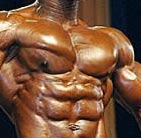
I thought I'd start things off with a bang, and although I don't feel it is the most important bodypart, it is the one that I get the most questions about. It is considered one of the "showy" muscles, and most definitely the muscle group that most people try to develop to the fullest. Some of you might be thinking biceps, but today we'll take a look at the chest, or pectorals.
Everyone wants a huge chest, plain and simple. It is all too common to see inexperienced lifters slaving away on endless sets of bench presses and cable crossovers in search of full, thick pecs. It is also used as a landmark for strength (although it shouldn't be). If I had a dime for every time I've heard someone ask that question we've all heard a million times, "how much do you bench?" I'd be rich. Anyway, the point is that the chest is a very important upper body muscle group to give that look of upper body thickness.
I am a huge believer in the basics. The bottom line for huge muscle gains is sweat, blood and hours upon hours of battling the iron. There are no shortcuts to any place worth going, and a huge chest is no exception. Some are genetically blessed with well-developed pectorals, and for others their chest lags behind. Either way, hard work and dedication is the most important factor.
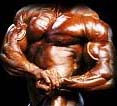 The chest is made up of two main heads, the pectoralis major and the pectoralis minor. To stimulate the chest using weights you will be using one of two motions: a press or a fly. If you want the most out of your chest workouts, the key lies in your pressing movements. Although flyes MAY have their place every once in a while, the pressing movements are where your strength lies. The more weight you can move through the range of motion, the more muscle fibers you can recruit. There is absolutely no replacement for heavy barbell presses, dumbbell presses and wide-grip dips. These are the core lifts and should always be the cornerstones of your workouts. Save the pec deck and cable crossovers for the pencil necked geeks on the treadmill; real men train with real lifts. (you don't have to eliminate them altogether, but use them sparingly).
Like I said before, it is very, very simple. There are no secrets, magic formulas or killer techniques that will "shock" your chest into growth. Stick to your basic presses, focus on overload and progression, and I promise that you will see great chest gains. Here are the most effective and non-effective lifts for packing muscle onto the chest:
Flat/Incline/Decline Barbell Bench Press:
A standard barbell press is the meat and potatoes of any effective chest routine. They are great compound movements that allow the lifter to handle the most weight through the given range of motion. The incline press will shift more of the stress to the upper region of the chest while the decline does the opposite, targeting the lower/outer region. The flat bench press works the upper and lower regions equally. I highly recommend a standard barbell press as a part of your chest routine.
Flat/Incline/Decline Dumbbell Press:
Dumbbell presses are another basic and highly effective movement for stimulating chest development. The main advantage they have over the barbell is that they allow you to move through a more natural range of motion, helping to prevent shoulder injuries. They also prevent strength imbalances from occurring since one arm can't cheat for the other. The only drawback is that you are not able to handle as much weight. Overall, a standard dumbbell press is an awesome movement that allows for great chest stimulation.
Dips:
An amazing movement for the chest that is often overlooked. Make sure to use a wider grip and lean forward to shift the stress from the triceps onto the pectorals. If the body weight is not sufficient then you can always add weight using a weight belt. Dips are an excellent compound movement for overall chest development.
Dumbbell Flyes:
An isolation movement for the chest that doesn't allow the lifter to use very much weight and limits overall muscle overload. Not the most effective lift for chest development, but may be used on occasion for variety and to keep things interesting. I would make sure to save this one for the end in order to save the most strength for the big compound movements like presses and dips.
Cable Crossovers:
Basically a standing flye. Pretty much the same idea as the flat dumbbell flye, and not the most effective lift. Save this one for last if at all.
Pec Deck:
Places a lot of stress on the shoulders and doesn't allow for very much chest overload. Overall the pec deck is not the most effective lift and I would avoid it altogether.
Here are some sample chest routines that are highly effective:
Flat Bench Press: 2 x 4-6
Incline Dumbbell Press: 2 x 4-6
Dips: 2 x 4-6
Incline Bench Press: 2 x 4-6
Dips: 2 x 4-6
Flat Dumbbell Press: 2 x 4-6
Incline Dumbbell Press: 2 x 4-6
Dips: 2 x 4-6
Flat Dumbbell Press: 1 x 4-6
Dumbbell Flyes: 1 x 4-6
All sets should stay within the 4-6 rep range and be taken to complete muscular failure.
So there you have it! That is all you need to know to make huge chest gains. Nothing complicated, just basic, sensible lifts and routines concentrating on compound movements and high intensity. There is nothing more to it than that! Good luck!
About The Author
Sean Nalewanyj is a bodybuilding expert and writer of top-selling Internet Bodybuilding E-Book: The Truth About Building Muscle. You can find more information by visiting his website: MuscleGainTruth.com